Who Invented the Paper Shredder? A Short History
Abbot Augustus Low patented an early paper shredder in 1909, while Adolf Ehinger is commonly credited with developing a practical machine in Germany in the 1930s. If you're asking who invented the paper shredder for everyday use, Ehinger is often the name given.
On this page (8 sections)
- Who invented the paper shredder?
- What did early paper shredders do?
- How did shredders become useful at home and work?
- How do modern shredder cuts compare?
- Which modern shredder fits your routine?
- How should you choose and set up a shredder?
- What mistakes make shredding harder?
- What should you buy after learning who invented the paper shredder?
Abbot Augustus Low patented an early paper shredder in 1909, while Adolf Ehinger is commonly credited with developing a practical machine in Germany in the 1930s. If you're asking who invented the paper shredder for everyday use, Ehinger is often the name given.
Those are two distinct milestones: an early patent and a later practical machine. The evolution that followed still matters when you shop, because cut pattern, run time, and capacity determine whether a modern shredder fits your paperwork.
Who invented the paper shredder?
Low holds an early paper shredder patent, and Ehinger is associated with the practical machine. Low's 1909 waste-paper receptacle patent describes cutting waste paper into small pieces and collecting it in a receptacle, with hand-operated and electric motor arrangements.
In the 1930s, German inventor Adolf Ehinger developed a shredder inspired by a hand-cranked pasta maker. Accounts of his reasons for building it vary, so the origin story should be treated with care.
The short answer depends on what you mean by “invented.” For an early patented design, Low is the name to know.
For a practical shredder, Ehinger is commonly credited. The distinction is useful because inventions often develop through multiple designs rather than one single moment.
What did early paper shredders do?
Early shredders cut unwanted paper into smaller pieces and collected the waste. Low's patent described a cutting mechanism and receptacle, while Ehinger's machine is associated with strip cutting.
A strip-cut shredder makes long, narrow strands. Those strips take up space and can be easier to align and reconstruct than shorter particles.
The simple mechanism suited the basic job of making discarded paper less readable.
Modern shredders still use strip cutting, but home and office buyers often compare it with cross-cut and micro-cut machines. Our guide to cross-cut vs. strip-cut shredders explains what changes when blades cut in more than one direction.
How did cross-cut shredders change paper destruction?
Cross-cut blades cut paper in two directions, creating shorter pieces than strip cutting. That makes reconstruction harder, while the actual particle dimensions and security level give you a clearer measure than the cut name alone.
The shorter pieces also pack differently in a bin. If you are comparing a cross-cut model with another type, see what a cross-cut shredder is for a plain explanation of the pattern.
How did shredders become useful at home and work?
Powered designs and machines made for different workloads brought shredding into everyday offices and homes. Modern choices range from occasional-mail machines to models built for longer sessions.
There was no single moment when shredders became common. For a present-day buyer, the practical question is how much paper you handle and how long you need the machine to run before a cooling break.
A compact home routine might involve a few envelopes and account statements each week. A small office may need to clear a taller stack in one sitting, so its owner should compare continuous run time and bin size as well as the number of sheets accepted per pass.
A higher sheet capacity only describes a pass. It does not mean the motor can run longer or the bin will need emptying less often.
Learn how the motor, blades, and sensors work together in how a paper shredder works.
How do modern shredder cuts compare?
Strip-cut makes strands, while cross-cut and micro-cut produce shorter particles. Smaller pieces are generally harder to reconstruct, but choose by security level and particle dimensions instead of relying on the cut name alone.
Cross-cut and micro-cut are useful categories, but their particle dimensions help explain the real difference. The Aurora AU1210MA makes shorter particles than the Fellowes 14C10, although both have a P-4 security level.
Run time and sheet capacity answer different questions. Capacity tells you how many sheets a machine can accept in one pass under its stated conditions.
Run time tells you how long you can keep shredding before a cooling period is needed.
For a focused comparison, read micro-cut vs. cross-cut shredders. The paper shredder buying guide covers cut type, security levels, and other features to weigh against your workload.
Which modern shredder fits your routine?
Choose a machine around your usual batch, desired cut, and shredding session length. These three models illustrate different tradeoffs without making one style right for every buyer.
The Fellowes 14C10 suits a home office that values a higher per-pass capacity and quiet operation. It accepts up to 14 sheets and has a 10-minute continuous run time, plus a safety lock and a pullout bin.
Choose the Aurora AU1210MA if you want a micro-cut model for longer sessions. It accepts up to 12 sheets, runs continuously for up to 60 minutes, and has anti-jam auto-reverse and a 5-gallon pullout bin.
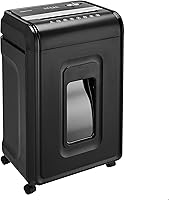
The Bonsaii C282-A fits a home office that needs a larger bin and a moderate batch capacity. It accepts up to 12 sheets of Letter-size, 20 lb paper, runs for up to 15 minutes, and has a 5.5-gallon pullout basket with a window to check the fill level.
How should you choose and set up a shredder?
Start with the documents you destroy, then match the cut, capacity, and run time to that routine. Measure the space where the shredder will sit and leave room to remove its bin.
For everyday household mail, cross-cut can be a sensible balance of shorter pieces and practical use. For paperwork where smaller particles are a priority, compare micro-cut models and check their stated security level.
A larger office workload calls for attention to run time and bin capacity, not only sheet capacity.
Before the first session, read the manual for the accepted materials and feeding limits. Put the shredder on a stable, level surface near an outlet, with enough clearance to open or pull out the waste bin.
Keep paper straight, feed it within the stated sheet limit, and pause if the machine signals overload or overheating.
Do not assume every model accepts the same extras. The Fellowes 14C10 handles paper clips, staples, credit cards, and unopened junk mail.
The Aurora AU1210MA accepts CDs, DVDs, credit cards, and small paper clips. Bonsaii says its C282-A handles CDs, credit cards, and staples, but excludes metallic cards.
What mistakes make shredding harder?
Overfeeding, ignoring cooldown limits, and choosing by one headline feature can lead to jams or an inconvenient routine. Feed a stack within the machine's stated capacity and let it rest when its run-time limit is reached.
A 14-sheet capacity does not make the Fellowes the best choice for every buyer. Someone who wants longer sessions may prefer the Aurora's stated run time, while someone who empties a bin often may value the Bonsaii's larger basket.
Do not force a jammed stack through the opening. Use the machine's reverse control only as its instructions direct.
The Bonsaii has manual reverse, and the Aurora has anti-jam auto-reverse, but correct feeding remains important.
Avoid shredding material that your model does not support. In particular, Bonsaii excludes metallic credit cards.
Keep hands, cords, and loose items clear of the feed opening, and empty the bin before shredded material reaches the blades.
For care, switch off and unplug the shredder before clearing scraps or handling the bin. Follow the manual's guidance for cleaning and lubrication, and do not spray aerosol products around the Bonsaii.
What should you buy after learning who invented the paper shredder?
Pick the Fellowes for larger passes, the Aurora for longer sessions, or the Bonsaii for fewer bin trips. The history answers who invented the paper shredder; your own workload should decide which current design belongs in your home or office.
Choose the Fellowes 14C10 if you value its 14-sheet capacity, quiet operation, and safety lock.
Choose the Aurora AU1210MA if you want micro-cut output and a stated 60-minute run time. Choose the Bonsaii C282-A if its 5.5-gallon basket and 15-minute run time suit your schedule.
If none matches your needs, compare cut types and capacity in the paper shredder buying guide before choosing a model.
Frequently asked questions
Who invented the paper shredder?
Abbot Augustus Low patented an early paper shredder in 1909, describing a waste-paper receptacle with cutting blades. Adolf Ehinger is commonly credited with developing a practical shredder in Germany in the 1930s, inspired by a hand-cranked pasta maker.
The two names refer to different milestones: an early patent and a later practical machine.
When was the first paper shredder invented?
An early paper shredder patent was granted to Abbot Augustus Low in 1909. Adolf Ehinger's practical shredder followed in the 1930s.
These dates describe different steps, a patented design and a later working machine, which helps explain why histories of the shredder sometimes give different answers.
Why were paper shredders invented?
Paper shredders cut unwanted documents into pieces, making their contents harder to read and reducing the bulk of waste paper. Document privacy became a major use for these machines.
The protection depends on the size of the pieces and how the shredded material is handled.
How have paper shredders changed over time?
Paper shredders expanded from early cutting mechanisms to machines with different cut patterns, sheet capacities, and run times. Modern home and office models may include powered feeding, reverse functions, and bin indicators.
Choose by the actual particle size and workload limits rather than the cut name alone.